1. Owning the definition before competitors do
Target query: why do you need time budgeting
Position: #1
Client: TimeCamp
URL: https://www.timecamp.com/blog/time-budgeting/
The opportunity
“Time budgeting” sits next to huge categories such as time management and time tracking, but the search intent is more specific.
The opportunity was not to create another generic productivity guide. It was to make the page that most clearly defines the concept.
What I did
I placed a concise, self-contained explanation near the top of the article, before forcing the reader through a long introduction.
That matters because definition queries reward pages that answer the question immediately and then expand on it.
The rest of the article supports that initial answer with benefits, practical applications, examples, and related questions.
Why it worked
Google does not always reward the longest page. For definition queries, it often rewards the page that makes the concept easiest to understand.
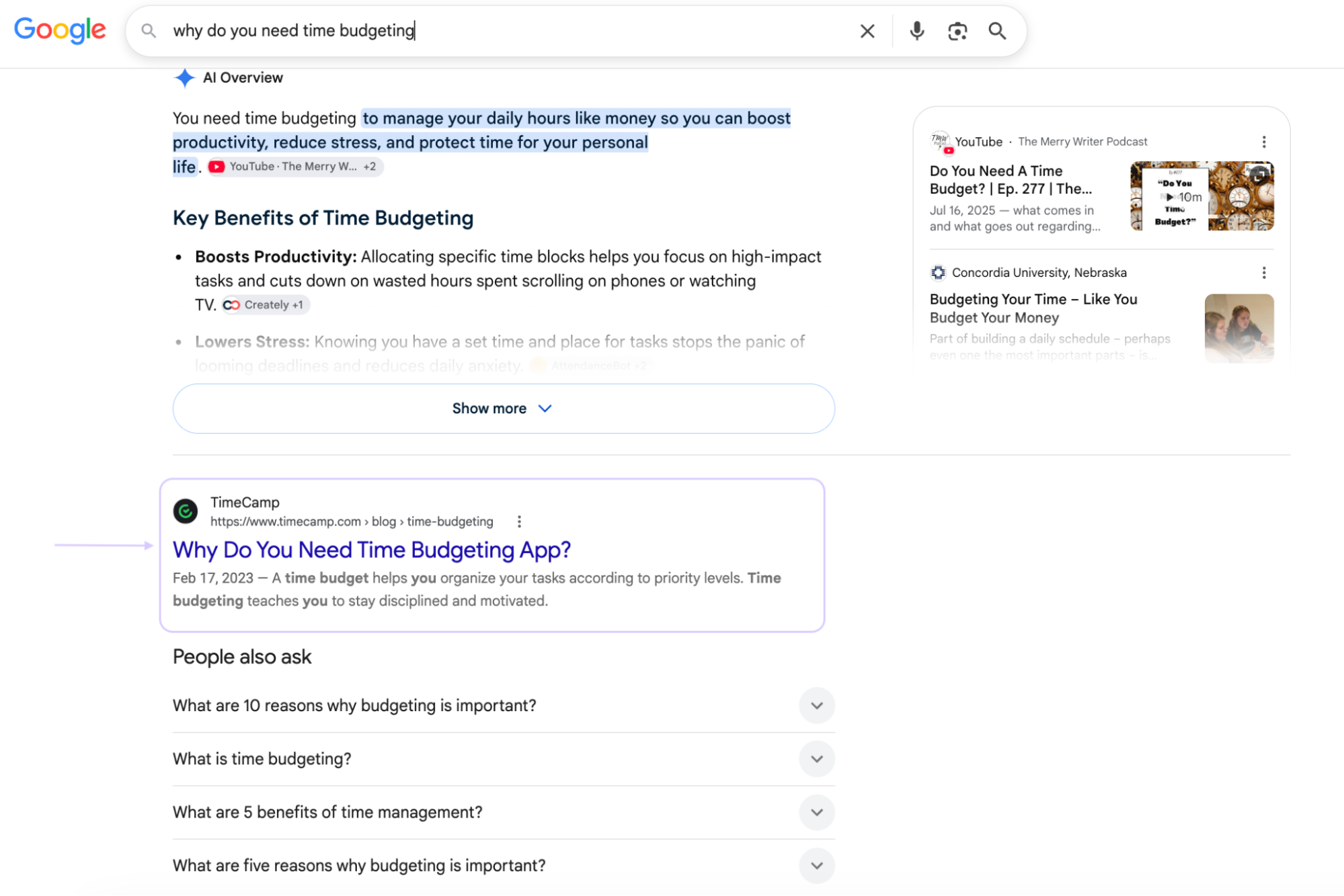
The screenshot shows TimeCamp holding the #1 organic result while the same definition is also surfaced prominently above the standard SERP.
Takeaway: when the market has not established a strong canonical definition yet, being the clearest source can be more powerful than trying to outwrite high-authority competitors.
2. Informational query, commercial reader
Target query: how to choose complementing crystals
Position: #1
AI Overview citation: Yes
Client: Conscious Items
URL: https://consciousitems.com/blogs/practice/crystal-pairings-and-combinations
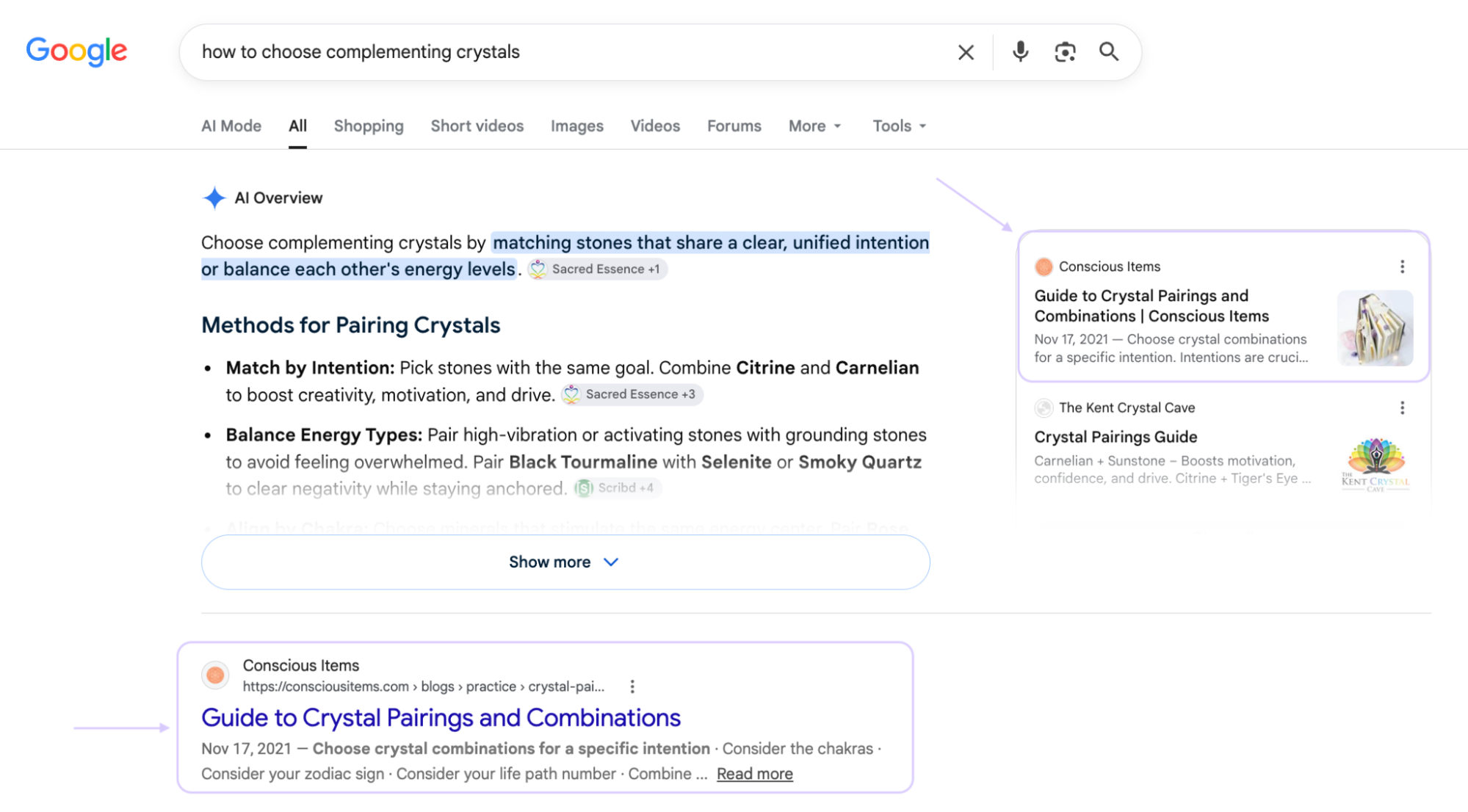
This article was originally published in 2021 and still occupies prime SERP real estate years later.
More importantly, the screenshot shows the brand twice: as the #1 organic result and as a source cited by Google's AI Overview.
The opportunity
Someone searching for crystal combinations is technically asking an informational question.
But commercially, they are usually one step further down the funnel: they already own or are considering one crystal and want to know what to pair it with.
Treating that person as purely informational would waste the commercial intent hidden inside the query.
What I did
The article genuinely answers the question first. Different crystal combinations are explained by goal and use case rather than simply being turned into a product list.
From there, contextual internal links connect relevant pairings with related product and collection pages.
Why it worked
The article satisfies both sides of the query:
Google gets a comprehensive informational resource. The business gets a path from organic discovery to product exploration.
That is what strong ecommerce SEO content should do. Traffic is not the final objective. Relevant traffic that can move deeper into the site is.
3. Recognizing when a “types of” query is really a comparison query
Target query: different types of virtual and digital bulletin boards
Position: #1
AI Overview citation: Yes
Client: Friday.app
URL: https://friday.app/p/digital-bulletin-boards
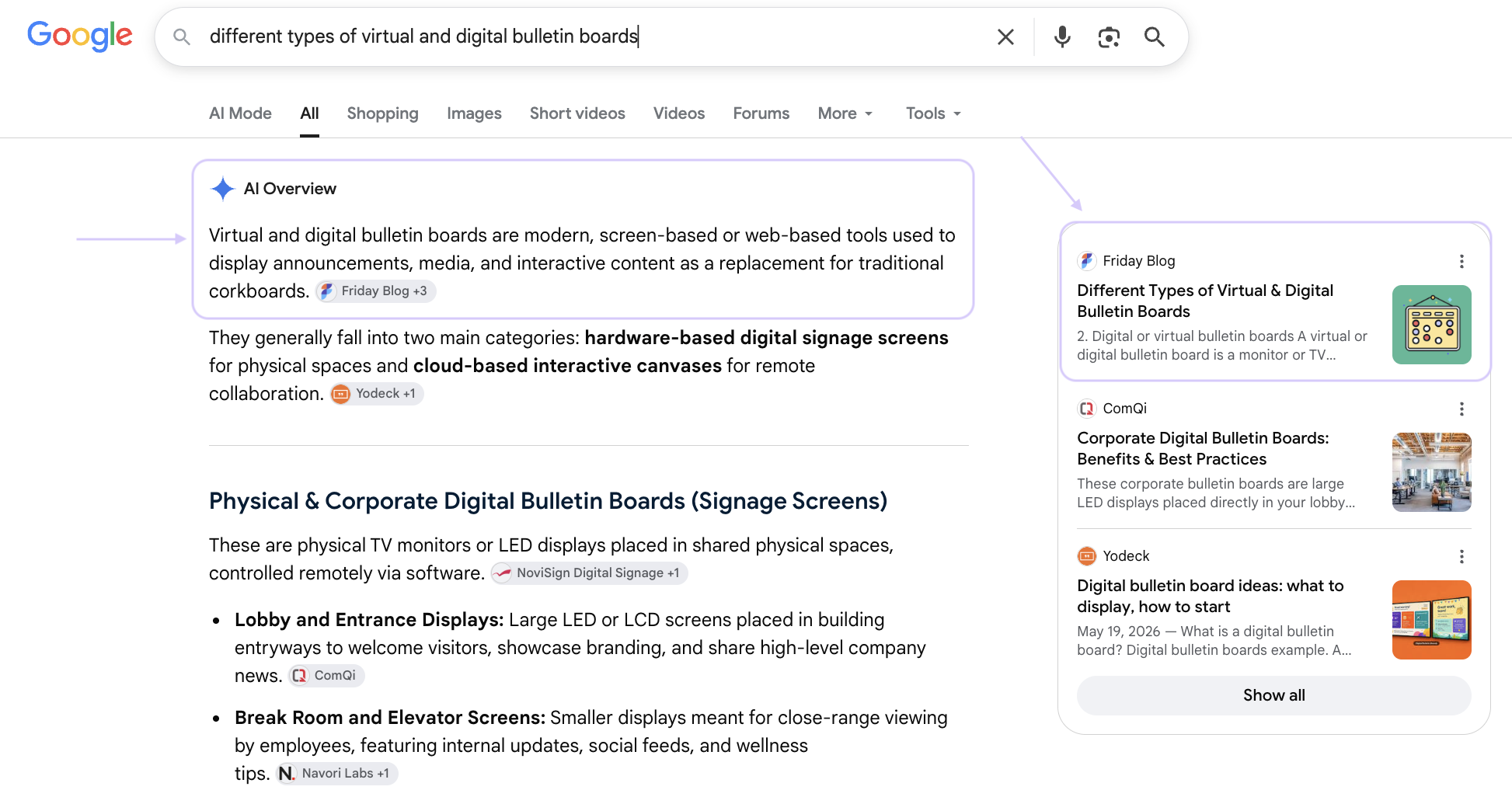
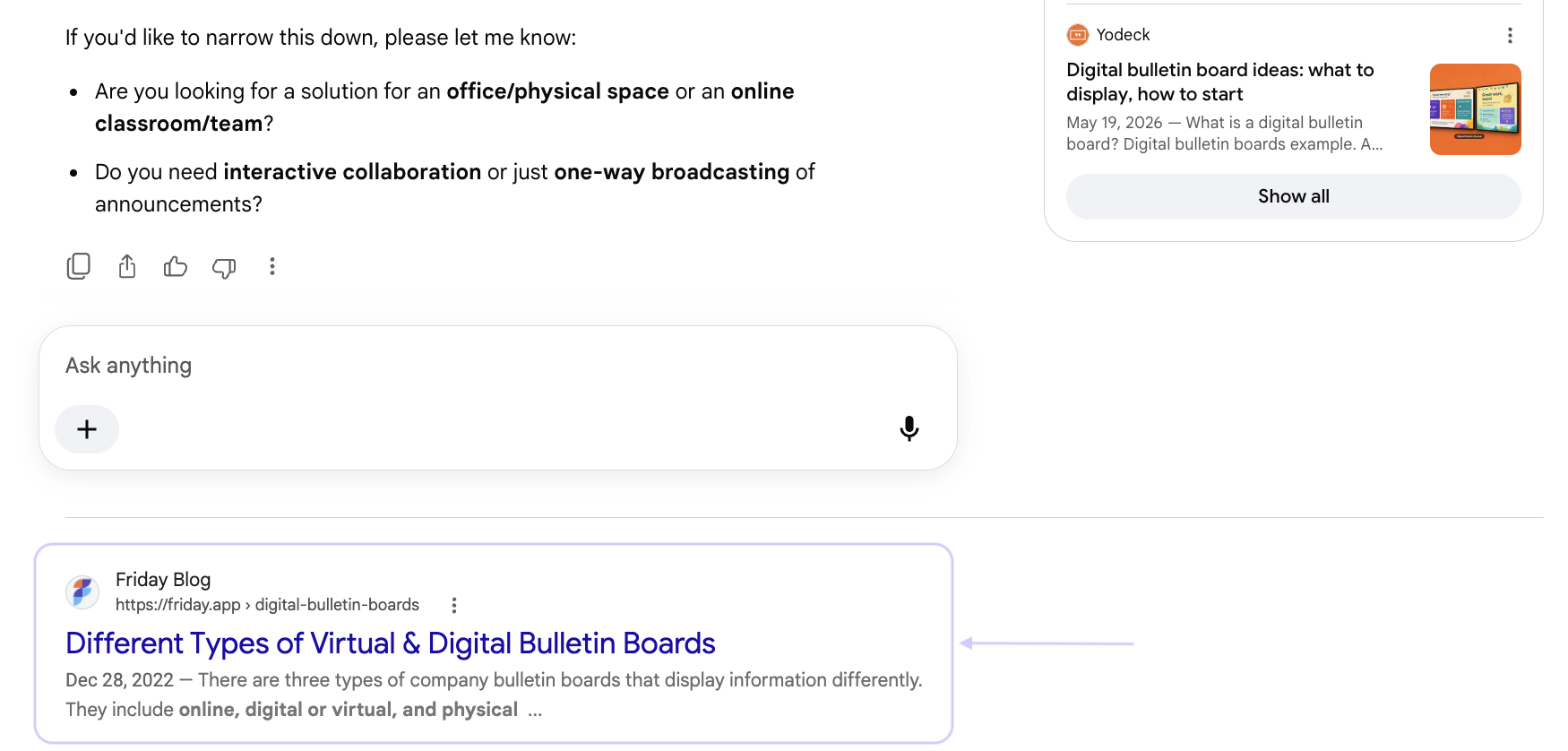
The page appears as the #1 organic result and is also cited directly inside Google's AI-generated answer.
The opportunity
A search containing “types of” looks informational on the surface.
But the reader is usually trying to distinguish between options.
Competing pages often make the user read several long sections and mentally compare each alternative themselves.
What I did
Instead of treating the article like a listicle, I structured the information comparatively.
The page establishes the main categories, explains the relevant differences, and makes those differences easy to scan.
Where comparison is the job the reader is trying to accomplish, structured information beats decorative prose.
Why it worked
This structure helps two audiences at once.
Readers can understand the options faster, while search engines and AI systems can extract discrete categories, characteristics, and comparisons much more easily.
Takeaway: formatting is not something added after SEO writing. For many queries, the information architecture is part of the SEO strategy.
4. Capturing the query and the next question on the same page
Target query: differences between a good reader and a poor reader
Position: #1
AI Overview citation: Yes
Client: Iris Reading
URL: https://irisreading.com/5-differences-between-a-good-reader-and-a-poor-reader-bonus-3-tips-to-become-a-better-reader/
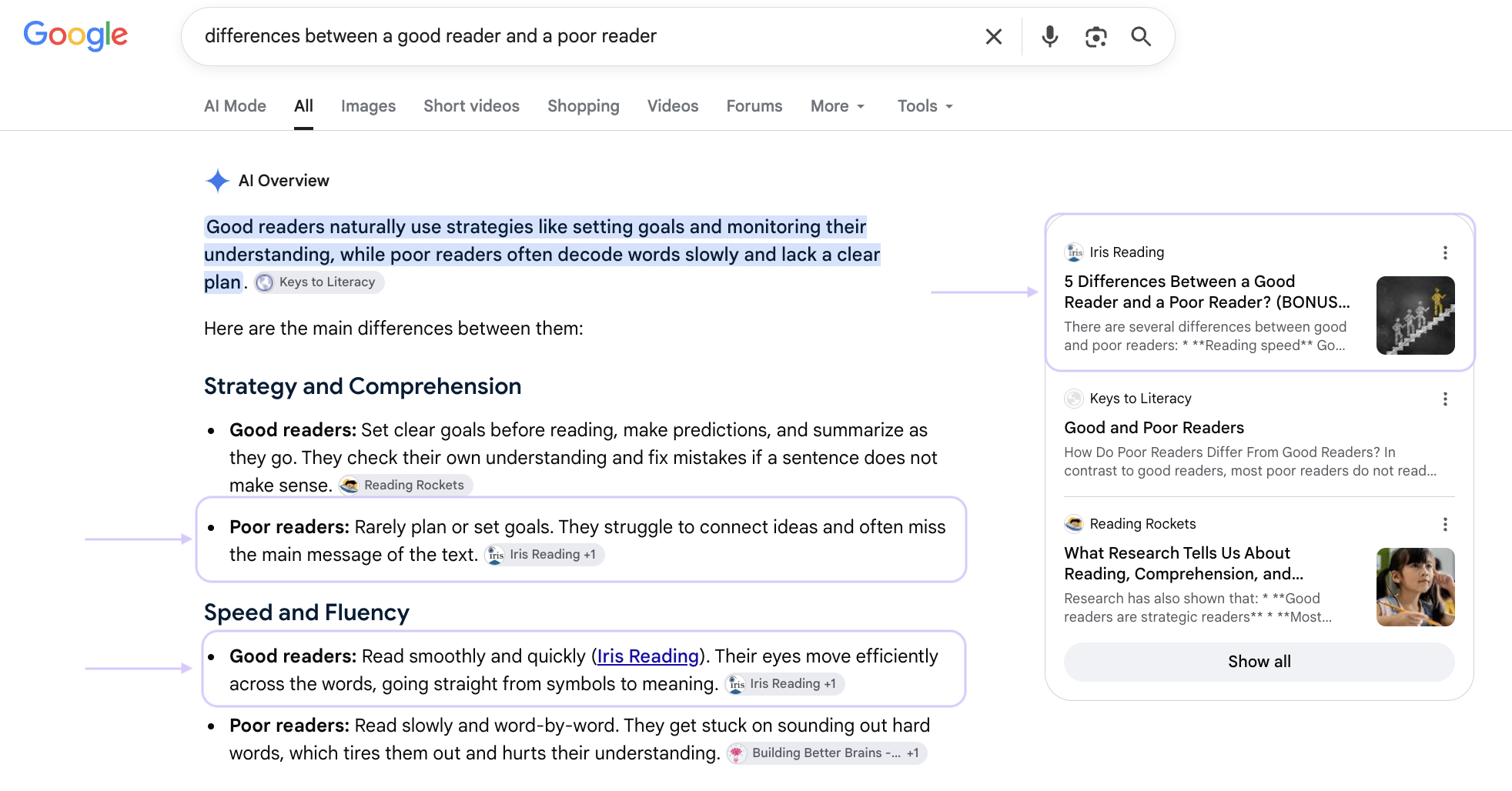
The page holds the first organic position and is also used as a source inside Google's AI Overview.
The opportunity
The primary query is comparative: What separates a good reader from a poor reader?
That makes the initial structure straightforward.
But SEO research should not stop at the literal keyword.
Once someone understands the differences, the natural next question is:
How do I become a better reader?
What I did
The differences are separated into clear, scannable sections rather than buried in long prose.
Then, instead of creating a second thin article around “how to become a better reader,” the page continues into actionable improvement advice.
Why it worked
One URL satisfies the original intent and the immediate follow-up intent.
That produces a more complete resource and avoids unnecessarily splitting closely related authority between multiple pages.
It is also increasingly important for AI search. A page that anticipates adjacent questions gives retrieval systems more usable answers from the same trusted source.
5. Building an entity page Google can trust
Target query: Jack Schwager career, life and net worth
Position: #1
AI Overview citation: Yes
Client: Earn2Trade
URL: https://www.earn2trade.com/blog/jack-schwager/
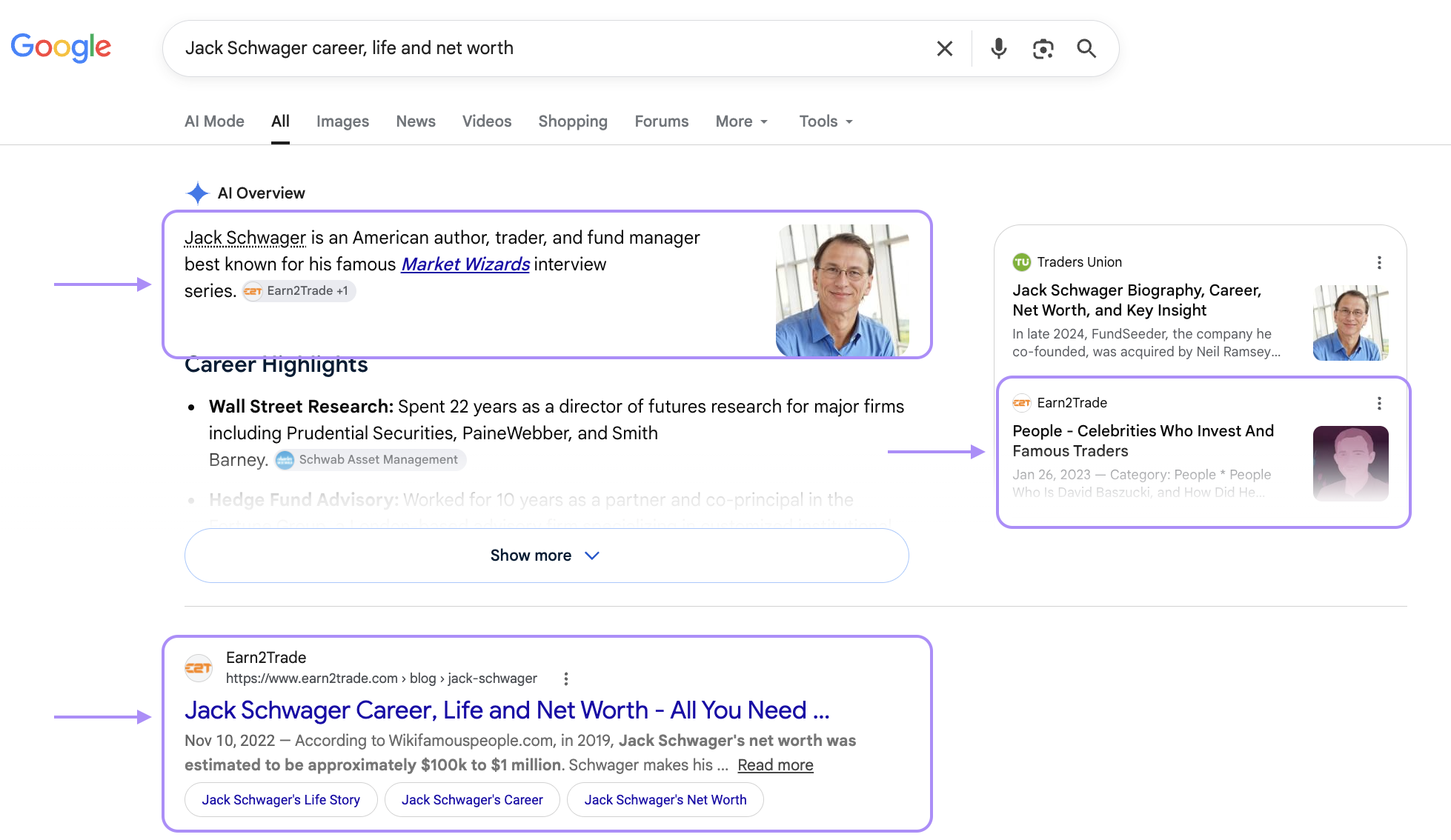
This SERP is especially interesting because the site does not just occupy the #1 organic result.
The screenshot also shows Earn2Trade surfaced inside Google's AI experience alongside another page from the site's broader content ecosystem.
The opportunity
A query about a person is not simply a keyword-matching exercise.
Google is trying to resolve an entity:
- Who is this person?
- What are they known for?
- Which facts can be trusted?
- How do they connect to other known people, books, companies and institutions?
What I did
The article was built more like a reference resource than a conventional blog post.
It uses consistent entity naming, verifiable biographical information, clearly separated career details, and explicit connections to the books, markets and institutions associated with Jack Schwager.
Why the content cluster matters
The screenshot illustrates something especially valuable.
The domain is not appearing just once.
Google has multiple relevant Earn2Trade resources available around the same topic and entity, giving the brand considerably more visibility across the SERP and AI-generated result.
This is why I rarely view SEO articles in isolation.
A strong page can rank. A strong cluster can make a domain look authoritative enough that Google repeatedly returns to it as a source.
Why it worked
Entity queries reward consistency, factual clarity and topical context.
The more convincingly a site demonstrates that it understands the wider subject around an entity, the easier it becomes for both traditional search and AI systems to treat that site as a useful reference.
6. Building a pillar instead of publishing an isolated article
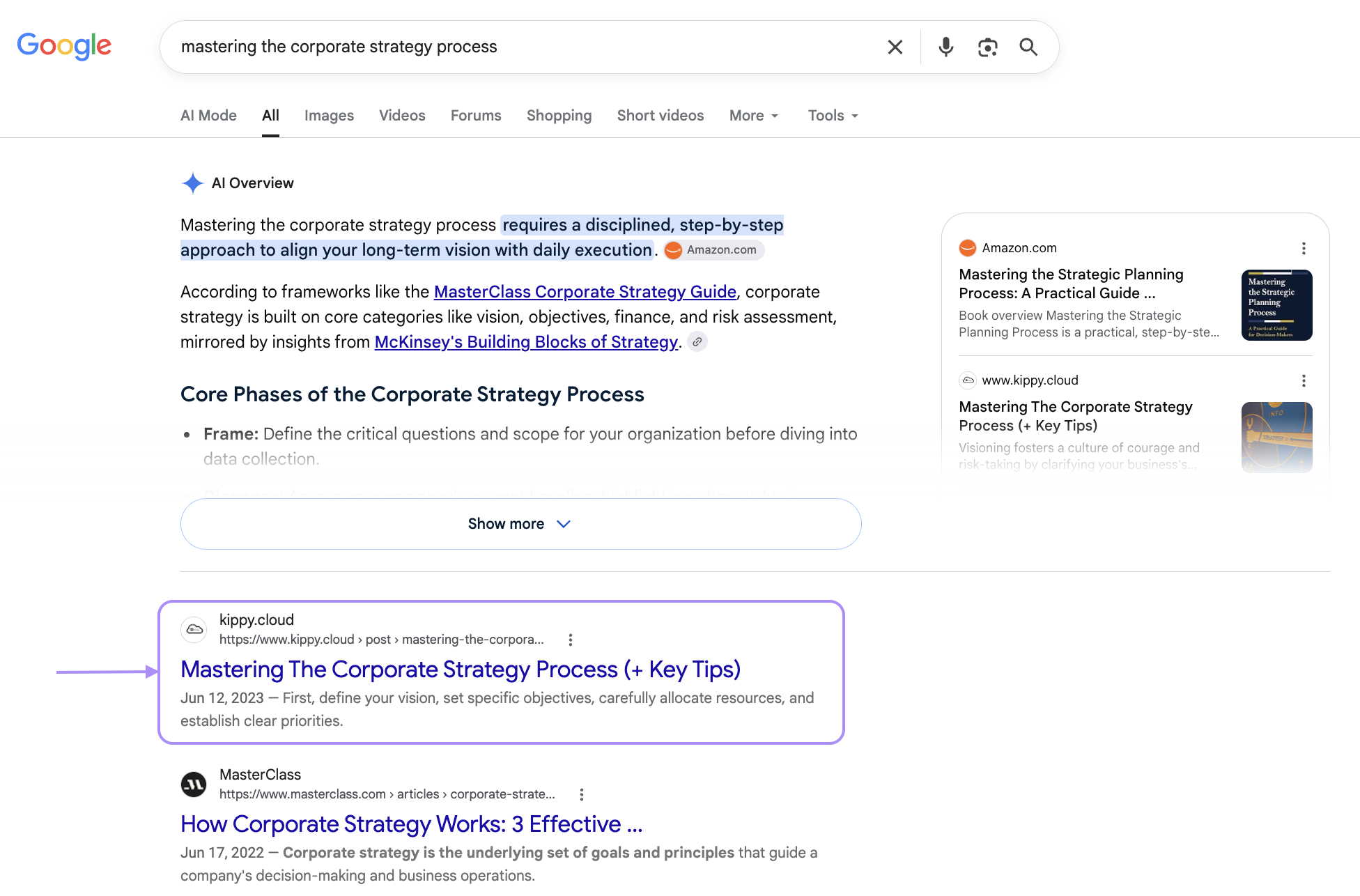
Target query: mastering the corporate strategy process
Position: #1
Client: Kippy Cloud
URL: https://www.kippy.cloud/post/mastering-the-corporate-strategy-process
The opportunity
Broad strategic queries are difficult to win with a single “SEO article.”
The page itself needs depth, but Google is also evaluating whether the site appears to understand the larger topic.
What I did
This page was designed as a pillar within a wider topic architecture.
It covers the core process comprehensively while related content addresses narrower concepts and sends internal authority back toward the pillar page.
That means keyword research happened at the cluster level, not only at the individual-page level.
Why it worked
Internal linking is often discussed as a final SEO checklist item.
I treat it as architecture.
If five supporting pages each answer one part of a subject while clearly reinforcing one central resource, Google receives a much stronger topical signal than it would from six unrelated posts.
The result here is a #1 ranking against substantially larger domains in the corporate strategy space.
Takeaway: sometimes the reason a page ranks is not only what is written on the page. It is what has been deliberately built around it.
7. Winning visibility in high-trust regulatory search
Target query: stay compliant with e-invoicing regulations Egypt
Position: #2
AI Overview citation: Yes
Client: Storecove
URL: https://www.storecove.com/blog/en/e-invoicing-regulations-egypt/
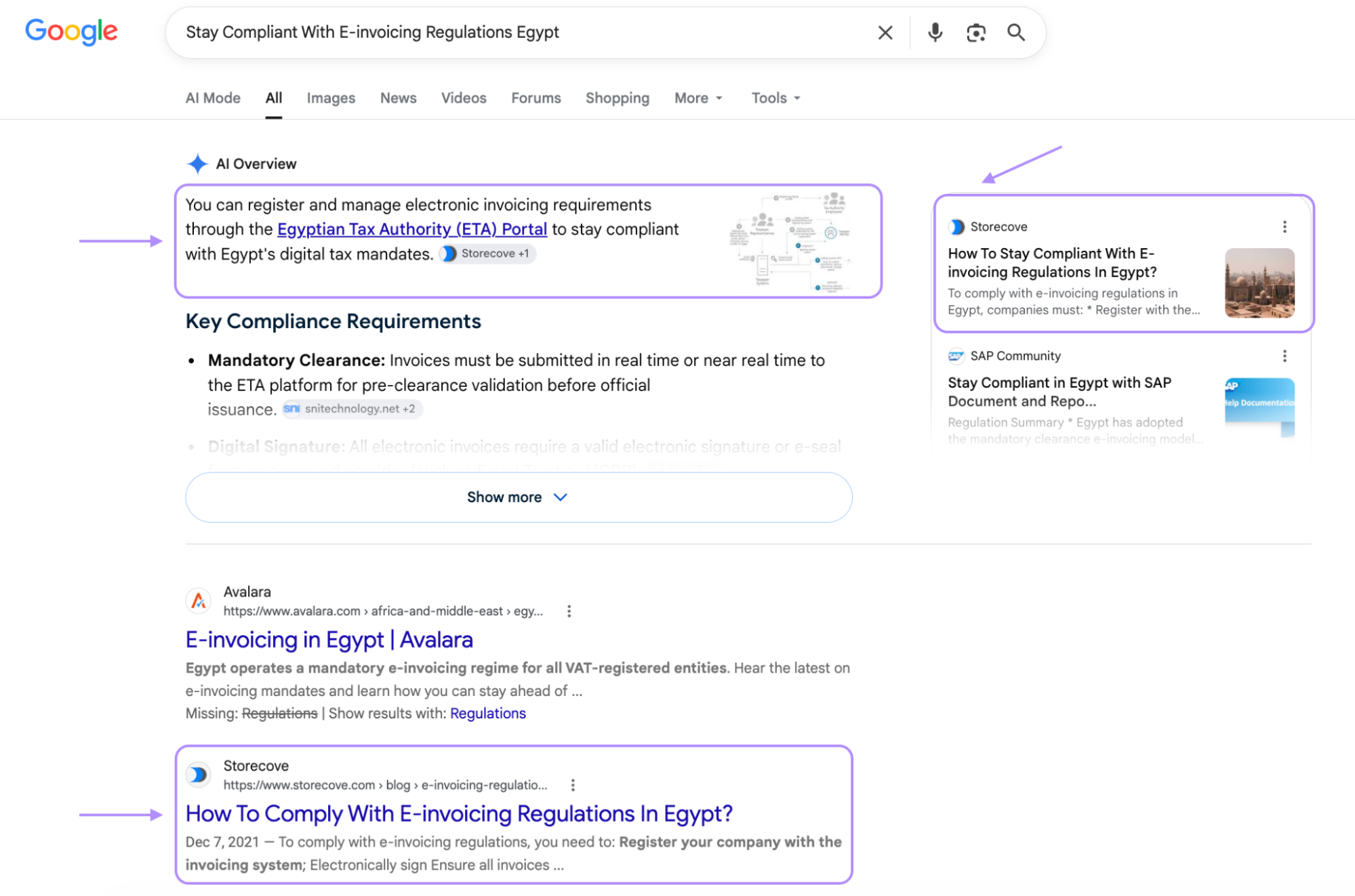
This example is technically not a #1 organic ranking.
I include it because it demonstrates something potentially more valuable: SERP ownership.
Storecove appears as:
- A cited source inside Google's AI Overview
- A visible source alongside the AI-generated answer
- The #2 standard organic result
One piece of content is therefore creating several opportunities for the brand to be seen on the same search results page.
The challenge
Regulatory SEO content has a different problem from evergreen informational content.
Accuracy is part of the ranking strategy.
Requirements change. Government terminology matters. Sources matter. A confident but outdated explanation can quickly become useless.
What I did
The article is structured around concrete compliance questions and requirements rather than padding the page with generic background information.
Important claims are tied to the relevant regulatory framework and authority, while sections are structured so individual requirements can be understood independently.
That modular structure also makes the content easier to review and update when regulations change.
Why it worked
For high-trust searches, the strongest content is not necessarily the most entertaining.
It is the easiest to verify.
That makes attributed, specific and extractable answers especially valuable for both search engines and AI-generated results.
And the goal is no longer necessarily “get the blue link to #1.”
If one article can earn an AI citation and a top organic ranking simultaneously, the brand can occupy far more of the search experience than a traditional ranking report suggests.
The SEO Content Method Behind These Rankings
These seven articles span productivity SaaS, ecommerce, workplace software, education, trading, corporate strategy and international e-invoicing.
The subjects are different.
The process is not.
1. Identify the real search intent
I start with the current SERP rather than the keyword in isolation.
What is Google already rewarding?
- A definition?
- A comparison?
- A tutorial?
- A reference resource?
- A commercial page?
Then I ask what the reader is actually trying to accomplish after entering that query.
2. Reverse-engineer the content gap
I benchmark the strongest competing pages for depth, structure and recurring subtopics.
Then I separate two things:
- What every successful competitor already covers
- What a reader would still want to know after reading them
The gap between those two lists usually reveals the strongest angle for the new page.
3. Choose the format around the intent
A comparison should look like a comparison.
A definition should answer the question immediately.
A regulatory article should make its claims easy to verify.
A pillar page should connect to a broader topic cluster.
SEO structure follows the reader's task rather than a fixed article template.
4. Build for extraction as well as reading
AI Overviews and answer engines have made information structure even more important.
I use concise answer blocks, explicit headings, tables where comparison matters, lists when a process is sequential, and clear factual attribution when trust matters.
The goal is not to “write for AI.”
It is to make information so clear and well structured that humans, search engines and retrieval systems can all understand it.
5. Support the page with internal authority
Before publishing, I identify existing pages that can meaningfully link to the new piece.
For broader topics, I map supporting content around the target page rather than expecting one article to carry the entire topic.
6. Optimize semantic coverage without writing by checklist
I use SurferSEO Premium to validate topical and semantic coverage.
AI research can accelerate SERP analysis, competitor research and outlining.
The final writing is done by hand.
Because optimization can tell you which concepts should be present.
It cannot decide which argument matters most, which example makes the concept click, or how to make someone keep reading.
What These Examples Have in Common
The #1 rankings are useful proof.
The more important pattern is that none of these pages reached the top because I applied the same “SEO article formula” seven times.
One needed to become the definition.
One needed to connect informational intent with ecommerce.
One needed comparison architecture.
One needed two consecutive intents on the same URL.
One needed entity authority.
One needed a topic cluster.
One needed regulatory trust and freshness.
That is the part of SEO content strategy I specialize in: working out what a page needs to become before writing it.
Want Content Built to Rank, Not Just Fill a Content Calendar?
I help SaaS, ecommerce and professional-service companies turn keyword opportunities into content strategies and search-optimized pages designed around real user intent.
SEO content strategy · Content briefs · SERP analysis · SEO writing · Content optimization · Internal linking · Topic clusters · AI search visibility